🚨TRUMP IN TOTAL MELTDOWN! - Colbert Revehals the "Hidden Truth" Live on Air! gtr
🚨TRUMP IN TOTAL MELTDOWN! - Colbert Revehals the "Hidden Truth" Live on Air! gtr
In today’s highly charged political media landscape, headlines often travel faster than context — and the recent viral narrative involving Donald Trump and late-night host Stephen Colbert is a clear example of how satire, commentary, and speculation can easily merge into online confusion.
A dramatic phrase — “TRUMP IN TOTAL MELTDOWN!” — has been widely shared across social platforms, alongside claims that Colbert allegedly “uncovered a hidden truth live on air.” While this wording sounds explosive, the actual situation reflects a broader trend in modern political entertainment: the blending of comedy, political critique, and heavily edited viral interpretations of late-night television segments.
🎭 Late-Night Comedy vs. Political Reality
Stephen Colbert’s late-night show has long been recognized for its satirical approach to U.S. politics, especially during election seasons. His monologues typically rely on irony, exaggeration, and performance-style humor to comment on political figures and media narratives.

In this instance, the idea of a “hidden truth” appears to come from how online audiences reinterpret comedic content. A single joke or sarcastic remark can quickly be reframed as a serious “revelation,” particularly when it is clipped, reposted, or stripped of its original context.
Media analysts point out that this pattern has become increasingly common:
Short video clips circulate without full context
Emotional or sensational headlines replace neutral summaries
Partisan audiences amplify interpretations that support their views
🧩 Why Trump Remains Central in Viral Political Content
Donald Trump continues to be one of the most prominent figures in American media discourse, and almost any mention of him tends to generate strong reactions across audiences.
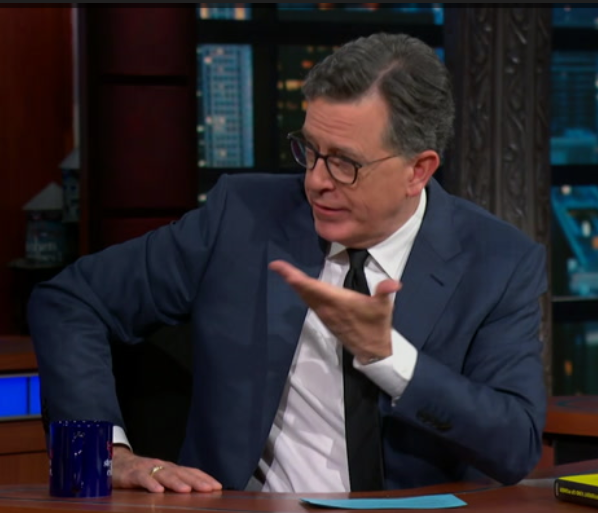
Within viral content ecosystems, his name is often linked with dramatic labels such as:
“meltdown”
“shock revelation”
“breaking moment”
“live TV outburst”
However, these descriptions are frequently editorial or user-generated rather than verified accounts of real events.
📺 The Rise of Edited Reality
Modern media consumption is increasingly shaped by short-form content, where context is often reduced or removed. A long-form monologue may become a brief clip; a sarcastic joke may be presented as a serious statement.
Experts in media literacy highlight that this environment can lead to:
Misreading of satire
Exaggerated reactions to edited segments
Rapid spread of misleading or emotionally driven content
⚖️ Satire, Politics, and Public Interpretation
Late-night programs like Colbert’s occupy a hybrid space between entertainment and political commentary. Because of this dual identity, audiences sometimes struggle to separate humor from reporting.
What is intended as satire or critique can easily be reframed online as:
factual reporting
insider disclosure
political exposure
This overlap is a key reason why viral narratives like this spread so quickly.
🧠 The Bigger Picture
Regardless of how it is interpreted — as humor, commentary, or misinformation — this viral moment reflects a broader reality of today’s digital environment: context is often lost in the speed of online sharing. In that space, figures like Trump and Colbert become symbolic reference points within an ever-shifting media narrative.
May you like



📌 Final Takeaway
The “TRUMP IN TOTAL MELTDOWN” headline is less about any confirmed real-world event and more about how political satire, content editing, and social media amplification can transform a comedy segment into something perceived as breaking news.